When you propose a corporate alumni network, one of the first questions you’ll hear is:
“Can’t we just use LinkedIn?”
It’s a fair one. Nobody wants yet another login. Your former employees are already on LinkedIn - perhaps in a group set up by one of your alumni. And LinkedIn is free.
So why invest in a dedicated platform?
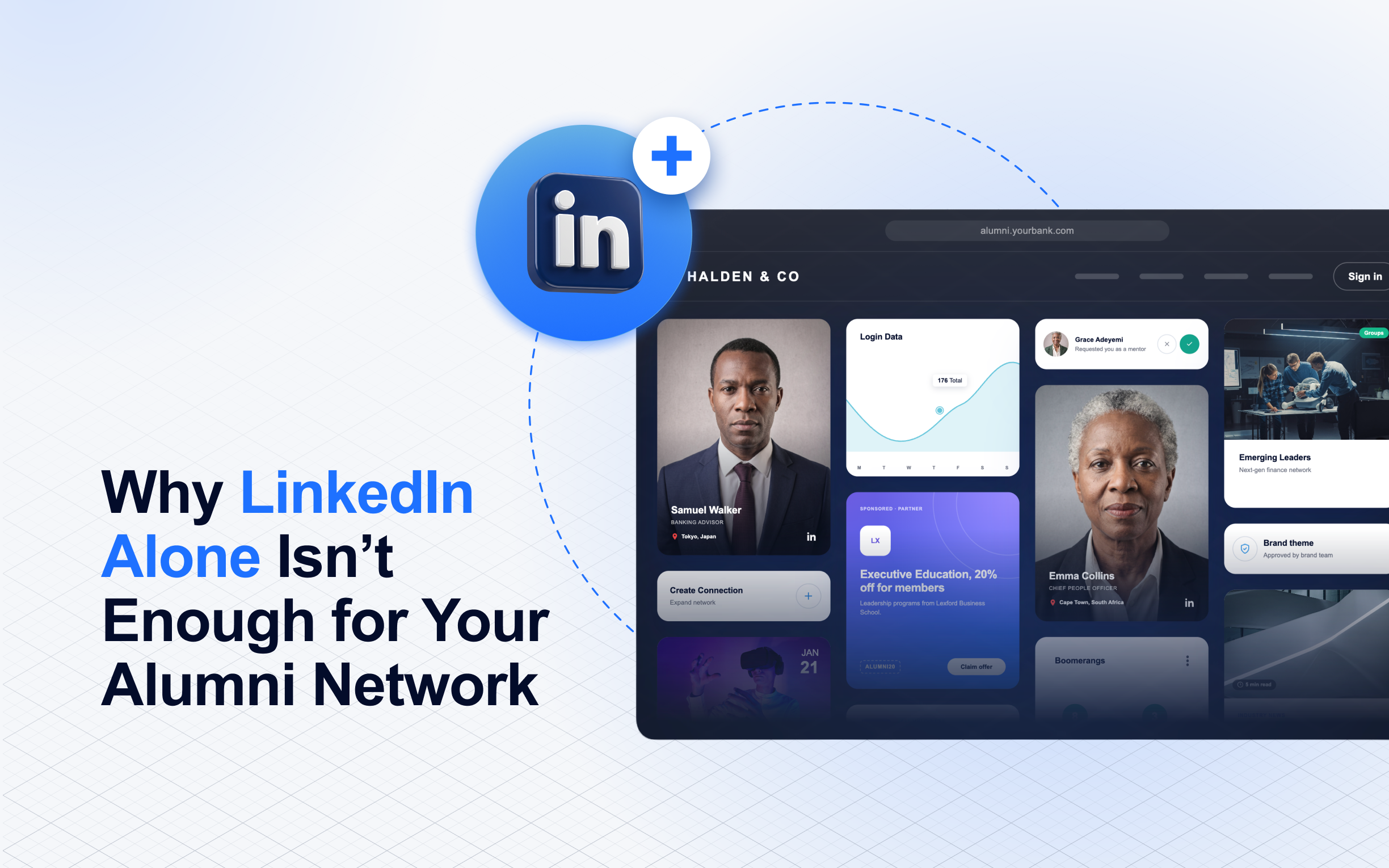
LinkedIn is a great way for alumni to find you, but it isn’t built to manage the ongoing relationship once they have.
For that, you need a space designed to connect each person with the right people and the right opportunities, not just show everyone everything. You need a dedicated platform.
What LinkedIn does well
There’s no doubt LinkedIn has a valuable role to play in any alumni strategy.
No other platform comes close for scale, visibility and discovery. It’s where your former employees already spend time, and where they’re most likely to notice that an official alumni program exists.
But it doesn’t do the real work you need it to. That’s where your alumni management platform comes in. In the same way a social media page funnels traffic to your website, LinkedIn is extremely useful for driving alumni to your platform. Both are important.
LinkedIn is also investing in Groups again in 2026, with better discovery and engagement tools. That’s good news for visibility.
But the limits of LinkedIn for alumni networking still remain, because it wasn’t built for that purpose.
The problem with the feed
LinkedIn’s feed is designed to show you as much as possible, from as many people as possible. That’s great for staying visible. But it works against a focused, engaged alumni community, for five reasons.
- It’s generic. The feed serves up everything from everyone. While it’s getting better, it isn’t closely tailored to where you live, where you are in your career, or what you need right now.
- More connections don’t mean more relevance. You might have thousands of connections, but you’ll only ever see a fraction of what they post. You have little control over whether an important update from one specific person ever reaches you.
- It’s built for people you already know. Social networks are designed to map your existing relationships, not to create new ones. Connection requests from strangers are often dismissed as a sales pitch or recruiter outreach.
- It’s a public stage. With more than a billion users and publicly accessible content, people naturally keep their guard up. A private community creates the trust that makes people more open and more generous with their time.
- It treats every alumnus the same. Someone who retired last year and someone who left two years ago for a competitor need very different things. A feed can’t tell the difference.
A connection isn’t a relationship
Joining a LinkedIn group takes one click. Because it’s so easy, the tie is weak.
On a dedicated alumni platform, members invest a little more. They share what they can offer, what they’re looking for and where they are.
That give-and-take is what turns a list of contacts into a genuine community.
From searching to matching
Imagine walking into a huge, beautifully designed supermarket packed with thousands of products from all over the world, when all you need is eggs, milk and bread. Twenty minutes later, you’re frustrated and still searching.
Now imagine a shelf at the entrance with your name on it, and everything you came for already waiting.
That’s the difference between searching and matching.
On LinkedIn, the user does all the work. Search for alumni in Atlanta, get 100 results. Filter by finance, get 50. Filter by tenure. Keep narrowing, and hope the right person appears.
A dedicated alumni platform with a matching engine does that work for them. Based on each person’s profile and activity, it proactively surfaces:
- The right people, including relevant former colleagues, mentors and contacts
- The right opportunities, whether that’s jobs, events or mentoring programs
Everything else is still there to explore. But what matters most to each person is front and center.
And matching isn’t only automated. It can also be curated.
On LinkedIn, no one’s interested in the outcome of your interactions. On a managed alumni platform, community teams do. They can spot opportunities and make introductions proactively, like noticing you’ve moved to Singapore and connecting you to local alumni there who may also have relocated from your former office.
That combination of smart technology and human support is something a generic feed simply can’t offer.
The value in building on ground you own
There’s a strategic reason to look beyond LinkedIn, too. When your alumni community lives on someone else’s platform, you’re building someone else’s asset.
- Your investment adds to LinkedIn’s value, not yours. Every hour your team spends growing a LinkedIn group strengthens LinkedIn’s network rather than your own.
- You get very little data back. LinkedIn offers limited insight into who’s engaging and what’s working, and its terms restrict how you can use that data. On your own platform, the data is yours to analyze and connect to your CRM and HR systems.
- You don’t set the rules. You have little control over who joins, and LinkedIn can change features, visibility or data access at any time, with no say from you.
When LinkedIn controls the platform and the data, one change on its part could cost you access to the community you’ve spent years building.
Your alumni community is extremely valuable, so don’t make it vulnerable.
LinkedIn and your platform work best together
That doesn’t mean you should abandon LinkedIn. The most effective alumni strategies use both, each for what it does best.
- Use LinkedIn for visibility: sharing announcements, celebrating alumni achievements and reaching former employees who haven’t joined your network yet.
- Use your platform for depth: for mentoring, jobs, events, introductions and anything else that depends on trust, relevance and a two-way relationship.
- Connect the two. Make every LinkedIn post and group point back to your platform, so curiosity turns into engagement.
LinkedIn does the discovery. Your platform builds the relationship. That’s how to make the case for a dedicated alumni management platform alongside LinkedIn.
Give your alumni a reason to engage
Your alumni will always be on LinkedIn. The question is whether you give them a reason, and a place, to go further.
A corporate alumni management platform from Aluminati gives your former employees a private, trusted space built around them.
It matches each person with the people and opportunities that matter to them, supported by a team that cares about the outcome. And it gives your organization full ownership of the community, the data and the relationship.
Book a private briefing to see how Aluminati can help you build a network that takes your alumni beyond the feed and delivers real value for both you and them.