If you’re a large, enterprise organization with capable tech teams, experienced developers and proven product leads, building a custom alumni platform in-house often seems like an obvious choice.
You know exactly what you want. You’ve got the talented staff on hand. And you know you’ll value the freedom and control to make sure it’s done right.
No waiting around for weeks for a single event page that doesn’t match what you had in mind.
So why not build your own alumni management platform?
The reality, however, is that an in-house build often involves more than most organizations plan for, including unexpected costs, delays and a platform that never feels ‘done’.
But if you understand those risks, then there are several pros to building in-house.
What are the benefits of building an alumni platform in-house?
Building an alumni platform in-house gives you full control over how your alumni platform looks, works and evolves.
If you’re an organization with a clear vision for your alumni program, complete control is a big draw.
When you take responsibility for the full build, the benefits include:
- Complete control over design and branding, with a platform that looks and feels like part of your organization, not a re-badged third-party tool.
- User journeys built specifically for your alumni. You decide the flows, the features and the priorities.
- A direct line to your developers, so you can quickly discuss changes and action fixes without waiting for your vendor.
- Full integration with your internal systems, without the headaches of how your platform interacts with existing HR, CRM and security infrastructure.
- Ownership. You never need to rely on a vendor’s roadmap, pricing or long-term future, or worry about being ‘locked-in’.
As is often the case, the pros of in-house builds only tell half the story. On paper, the benefits are strong and rational, yet the reality can be very different.
The realities of an in-house build
It’s easy to make a decision about an in-house build based on the benefits on paper and your detailed project plan. But the challenges of building your own alumni platform soon start to show up when development begins.
1. Requirements outpace development timelines
Building a full community platform isn’t quick. It takes years to do correctly. And while your development team is working to a scope you sent last year, your user needs have shifted by the time it’s ready to deploy.
One global bank we spoke with spent around $1 million a year for five years on an in-house build. At the end, all they had was a setup doing exactly what they’d wanted five years earlier.
2. “Done” is never done
Internal tech teams are usually set up to deliver projects. Once it’s delivered, it’s closed, and the team moves on.
But an alumni platform isn’t a one-off project. It’s a product that has to evolve with your community. Whatever you launch, you’ll likely want to change within six months - with new features or a different look - and every change request will eat into your internal developers’ time, taking them off other future projects.
3. Security becomes your responsibility
An alumni platform is accessible by design, and holds personal data on thousands of former employees, many of them clients. For a high-profile bank, law firm or corporation, that makes it a target. Attackers look for the weakest point.
“Vibe coding” makes building software look faster than ever. While it might be acceptable for low-risk internal tools, it’s not how you leverage AI safely for an alumni platform.
4. The work continues after build
Running your own platform means maintaining it. APIs change, interfaces change, new vulnerabilities appear, and hosting and infrastructure need constant attention.
Even the best-resourced organizations run their in-house alumni platforms with several full-time staff, plus ongoing support from technology and operations. Most alumni teams are two or three people, so do you have the resources to handle a custom product?
5. The costs add up
Large technology projects are notoriously hard to keep on track. Research by McKinsey and the University of Oxford found that large IT projects run 45% over budget on average, while delivering 56% less value than predicted. Every extra year of a project adds to the overrun - and your alumni platform is a years long commitment.
Add up the developers, the time, the maintenance, the security and the hosting, and an in-house build almost always costs more than buying a platform off the shelf.
Questions to ask before you commit to an in-house build
If you’re weighing up an in-house build, answer these questions to see if it's a good fit for your organization:
- Who will maintain the platform in year three, and is that budgeted?
- Who patches it when a new security vulnerability is announced?
- What happens when your lead developer leaves?
- How quickly can you change a page or add a feature when your alumni team asks?
- What’s the true five-year cost, including people, hosting and security?
- Will your security team sign off on an internet-facing application holding alumni data?
If the answers are clear and resourced, you’re in a strong position. If they’re not, a custom build might not be for you.
But there is another way to get the benefits of an in-house build without the resource headaches.
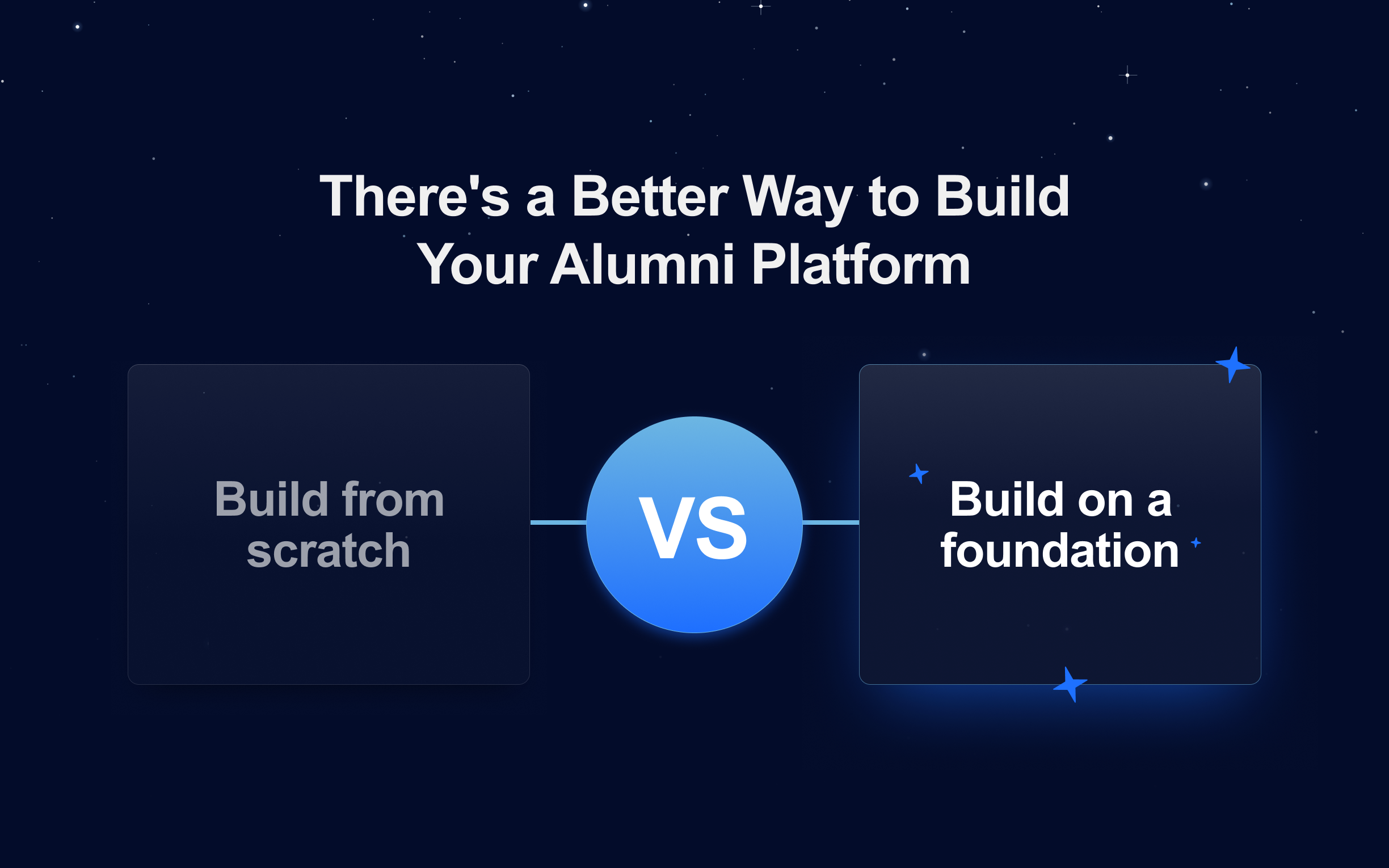
The third option: build on a foundation, not from scratch
Developers rarely code everything from scratch anymore. They build on frameworks that already handle the foundations so they can focus on what makes their product unique.
That same approach works for alumni platforms.
Aluminati’s Community Builder gives you the flexibility of an in-house build without the long-term burden.
You get a platform that looks, feels and works like you built it yourself, with full control over design, branding, structure and user journeys. You add the modules and features your alumni platform needs. And then it stays flexible, so you can keep making any changes you want, reacting to user demands as and when you need to.
Better still, Aluminati takes care of those costly challenges that drain in-house teams:
- No need to start from scratch - we’ve done all the beta testing with five years of development and six previous versions.
- No need to divert resources - we’ve got the specialist to meet your requirements.
- No need to worry about security or maintenance - we take care of all the infrastructure, patching and product update requirements.
There are two ways to use the Aluminati Community Builder:
- Your team builds on it. Your developers get a secure, enterprise-ready foundation to build your platform their way, years faster than starting from zero.
- Our team builds it for you. No developers to spare? Our team can build and configure your platform to your specification.
And because we work with highly regulated global organizations including leading banks and law firms, Aluminati is ISO 27001 certified and the platform is built for enterprise security from day one.
Don’t default to building an alumni platform in-house
If you’re serious about building in-house, and you have the vision, the commitment and a clear idea of what you want, you're in a strong position.
The question is whether you start from zero, or from a foundation that accelerates your project by years, reduces your costs and removes the long-term headaches of maintenance and security.
Aluminati gives you the control you want, without you spending years of development time and cost only to find the results are already outdated.
You don’t need to become a software company to get the alumni management platform you want.
Book a private briefing today and see how the Aluminati Community Builder is the ideal framework for your enterprise.